

AI Was Supposed to Save Time. It Removed the Limits on Work
The hidden tradeoff between efficiency and freedom in the age of AI

Hey Productivity Explorer,
Lately, I’ve been thinking about AI and productivity, not from a technical perspective, but from a human one. Something about the way we are using these tools feels slightly off, and it took a small moment to make it clear.
Yesterday evening, I missed something that mattered.
I was driving with my family to dinner. Everyone in the car was laughing, talking, fully present in the kind of ordinary moment that makes up most of life. I remember looking at them and realizing I could see it happening, but I wasn’t actually part of it.
My mind was somewhere else.
I was replaying an AI use case at work, refining the architecture in my head, thinking about edge cases, scalability, and what I needed to clarify for my team. It was a good problem. The kind that feels meaningful. The kind that rewards attention.
And the deeper you go into a problem like that, the harder it is to come back.
At some point, I heard my name.
I had missed the entire exchange. I don’t even remember what they were laughing about.
Nothing dramatic happened. But something felt misaligned.
And it wasn’t the first time.
The uncomfortable truth is that I love this work.
The Seduction of Acceleration
I enjoy solving hard problems. I enjoy building systems that make organizations smarter and faster. AI makes that possible in ways that were not accessible even a few years ago. Tasks that once required days of coordination now take hours. Processes that once required teams can now be orchestrated through well-designed systems.
It feels like leverage. It feels like progress.
But the more powerful these tools become, the more they remove friction. And when friction disappears, constraints disappear with it.
That’s when something subtle happens.
If you can respond faster, expectations rise; if you can analyze more, demands increase; and if you can produce more, that higher output becomes the new baseline.
No one formally declares it.
The standard simply shifts.
AI did not just increase productivity.
It removed the limits that used to protect us from expansion… and when that happens, work expands to fill the new space.
For a while, I assumed this was personal. Maybe I needed better boundaries. More discipline. More intentional presence.
But the pattern shows up everywhere because organizations are moving faster than ever.
Yet almost no one feels like they have more time.
If anything, the opposite is true.
AI was supposed to reduce the workload. Instead, for many people, it has increased it.
That shouldn’t surprise us. When something becomes easier, we rarely stop doing it.
We do more of it.
We do more analysis, more reporting, more communication, more optimization.
Capacity increases, demand recalibrates, and what was once acceleration becomes obligation.
The Expansion Effect
This is not a flaw in AI.
It is a structural property of modern organizations.
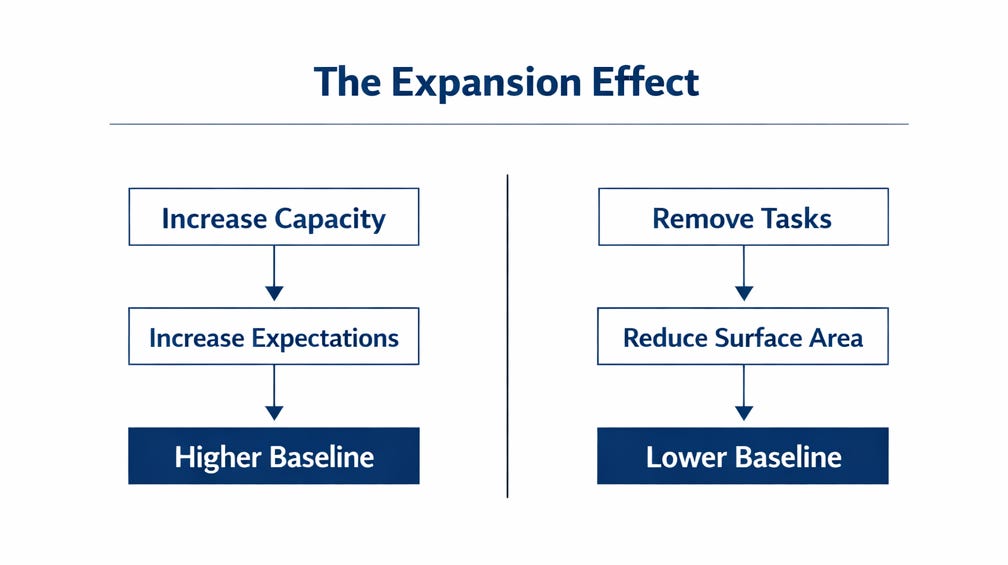
Organizations reward visible output. They reward responsiveness and throughput. They do not reward elimination or simplification. They do not reward saying, “This no longer needs to exist.”
So when AI increases output capacity, expectations rise automatically.
Faster systems create higher baselines, and higher baselines become normal.
This is the expansion effect. Every time we remove friction, we expand the surface area of work.
Email and social media removed friction from communication, so communication exploded.
Data tools removed friction from analysis, so analysis multiplied.
AI removes friction from cognition itself, so cognitive work expands.
This is the core tension:
We did not use AI to save time.
We used AI to remove the ceiling in our work.
There are two fundamentally different ways to deploy AI.
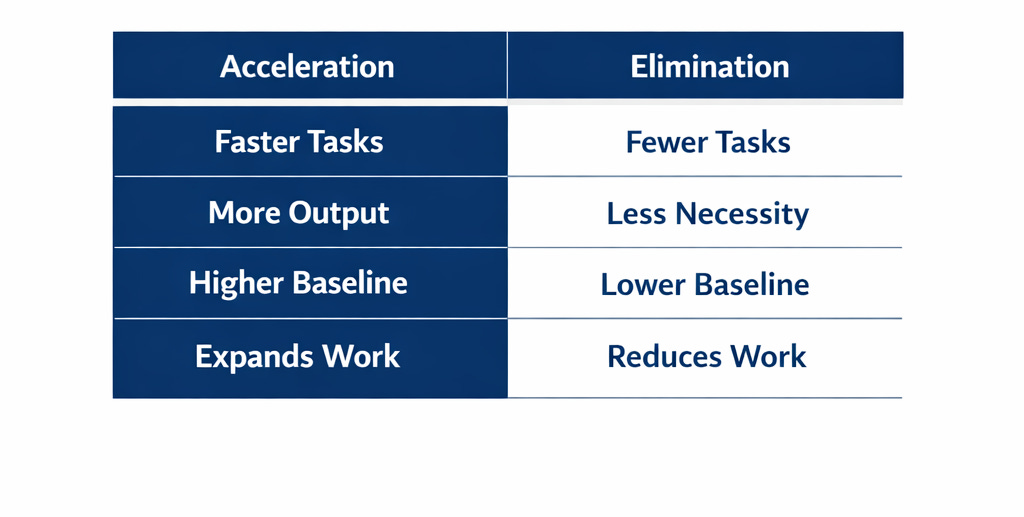
The first is acceleration.
Write faster, analyze faster, produce more.
This increases throughput, and it also increases volume.
I have seen executive teams implement real-time dashboards, expecting faster decisions. Instead, meetings grew longer, and more data invited more discussion. More variables require more validation, so the decisions did not accelerate. They became heavier as more information does not always produce clarity.
Often, it produces drag.
The second approach is elimination.
Instead of accelerating tasks, you question whether the task should exist at all.
Instead of generating more reports, you remove the need for reporting.
Instead of increasing communication speed, you reduce the need for communication through better system design.
Instead of expanding analysis, you define decision rules that make additional analysis unnecessary.
Same technology but completely different philosophy.
One expands work.
The other reduces it.
Most organizations never move past acceleration.
Because elimination requires restraint, and restraint is rarely rewarded.
Now return to that car ride.
AI did not just make work faster.
It made the work ambient, portable, and always available.
It reduced the cost of thinking about work to nearly zero.
And when the cost approaches zero, usage approaches infinity.
Attention starts to fragment.
Part of your mind remains tethered to optimization, even in moments meant for presence.
It feels productive.
But over time, it changes something fundamental.
When more is always possible, done disappears, and when done disappears, rest becomes guilt.
That is the part we are only beginning to notice. I still catch myself doing it.
The Shift We Haven’t Made
The problem is not AI.
The problem is that we have not changed what we optimize for. We optimize for speed, volume, and responsiveness.
AI is extraordinarily good at delivering those outcomes.
But faster is not the same as better, and it is certainly not the same as less.
If we do not deliberately redesign how work behaves, AI will not reduce it.
It will amplify it quietly.
One improvement at a time, one new baseline at a time, until the space we thought we reclaimed is quietly filled again. The shift is simple to describe, but difficult to execute.
If AI makes you busier, you are using it incorrectly.
The goal should not be to increase output; in fact, it never was.
It should be to reduce the necessity.
Less busywork, less noise, and no need for constant engagement.
That creates more space to think, more depth, and more presence.
AI should remove categories of work, not accelerate them.
That is the direction I am exploring with SolveWithAI.
Not more tools.
Less work.
Talk soon,
Sameer Khan
Creator of Solve with AI.